
Leadership, interrupted: Youth Day edition
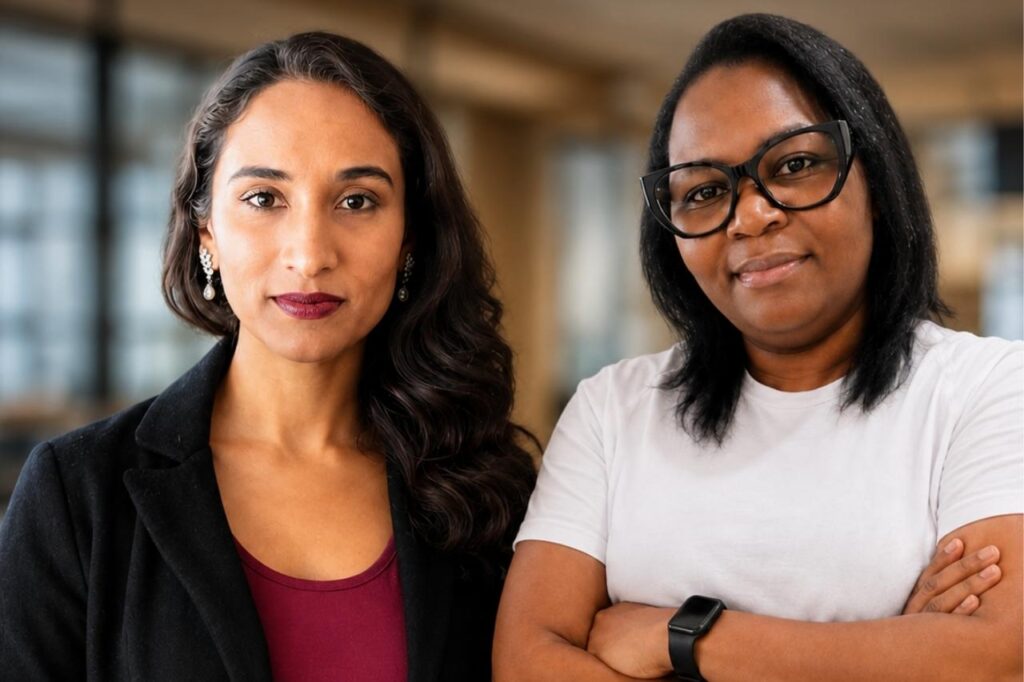
Two Citizen Leader Lab team members join the DGMT Fellowship this July
As part of Youth Month, we have profiled Dipuo Mafatle and Zah’Rah Khan, who have both been selected for the DG Murray Trust Fellowship, a highly regarded, cohort-based leadership programme that brings together professionals from across sectors to engage with complex social and organisational challenges through structured dialogue, reflection and peer learning.
Their selection is particularly noteworthy given the competitiveness of the process, which attracted 64 applications from across the country.
Rather than a traditional training programme, it is designed as a developmental journey that exposes participants to different perspectives and ongoing reflection. The focus is on how leaders understand and make sense of their contexts, rather than only how they operate within them.
As part of the Fellowship experience, the two team members will also collaborate on a joint project to translate insights from the programme into practical learning and value for Citizen Leader Lab.
Ahead of the programme commencing in July, we spoke to Dipuo and Zah’Rah about their expectations, and what this moment represents in their work at Citizen Leader Lab.
What drew you to the DMGT Fellowship, and why does it feel relevant to you at this point in your life?
Dipuo: I was drawn to the DGMT Fellowship because it offers an opportunity to learn alongside people from different backgrounds who are all committed to making a positive contribution in their communities and organisations. I am naturally curious about leadership, personal growth, and how people can work together to address complex challenges and this Fellowship seems like a space where those conversations can happen in a meaningful way.
Zah’Rah: I see this Fellowship as both a pause and a provocation for how I work going forward. It is also an opportunity to step outside the immediacy of daily work and think more critically about leadership and its impact.
At this point in my life, I’m interested in developing how approach my work, not just accelerating productivity. Our work at Citizen Leader Lab engages with complexity every day, and this felt like a chance to view those patterns with fresh eyes.
The Fellowship brings together people from different sectors and backgrounds. What value do you see in learning in this kind of shared space?
Zah’Rah: There’s something useful about being out of your own community, you know, where your usual shorthand doesn’t work. It makes you more conscious of the ideas and language you default to. It also stretches how you define problems and what you consider possible.
This kind of friction is actually quite familiar at Citizen Leader Lab. Our work regularly brings together people from all walks of life. The value of a space like this is not necessarily in finding consensus, but in being challenged by different ways of thinking and then returning to your own context with a clearer sense of what needs to change, and what still holds true for you.
Dipuo: One of the things that excites me most about the Fellowship is the opportunity to engage with people whose experiences, perspectives and areas of expertise are different from my own. We often approach challenges through the lens of our own work and background, but some of the most valuable insights come from hearing how others think about and respond to similar issues.
Many of the challenges facing our communities and organisations are complex and interconnected, which makes collaboration across sectors especially valuable.
As you begin this process, what is one idea about leadership that you are open to rethinking?
Dipuo: One idea about leadership that I am open to rethinking is the belief that strong leaders should always appear confident and certain. For a long time, I associated leadership with having clear answers, making decisive decisions and projecting confidence at all times.
As I have gained more experience, I have started to realise that leadership often involves navigating uncertainty, asking difficult questions and being willing to acknowledge what you do not know. I hope the experience will challenge my assumptions and help me better understand how authenticity, curiosity and adaptability contribute to meaningful leadership.
Zah’Rah: I am open to rethinking leadership as something that rests primarily in individuals or formal roles. Much of my experience suggests leadership is often distributed.
I want to explore how leadership shows up in that less ‘’conventional’’ sense. This includes creating the conditions for others to lead. Citizen Leader Lab’s work is a prime example of this, especially in schools where leadership often shows up in unexpected ways. I want to interrogate how much we over-index on positional leadership and under-value the less obvious forms that actually keep systems, institutions and communities together.
Beyond your own development, how do you think this experience might influence the work of Citizen Leader Lab?
Zah’Rah: I hope the experience will bring new perspectives into how we think about leadership development.
Citizen Leader Lab is already part of a rich ecosystem of leadership practice, and this Fellowship offers a different angle to interpret it. I’m particularly interested this exposure might strengthen our storytelling, as well as our and monitoring and evaluation work.
Dipuo: There is value in exploring how leaders and organisations in different sectors approach leadership development, partnership and community engagement. The opportunities and challenges they encounter may provide useful insights for the work we do and help me look at aspects of our work from different angles.
This could influence the questions I ask, the contributions I make in discussions with colleagues, and the way I engage with programme participants.
What does leadership that responds to today’s challenges look like to you, especially for young people and future leaders?
Dipuo: I believe that authenticity and humility are important qualities for future leaders. People are more likely to trust and engage with leaders who are genuine, willing to listen and open to learning from others.
For young people and future leaders, this means developing the ability to build relationships, work across differences and remain open to growth.
Zah’Rah: For young people, it is about agency — not waiting for permission to think, question and act. It is also about collaboration.
It means acknowledging our history as a country but not being shackled by it, and also committing to the work of making amends where necessary. It is about being fair and just, and not being tone-deaf to the world we live in. It is inclusive, conscious and attentive.
